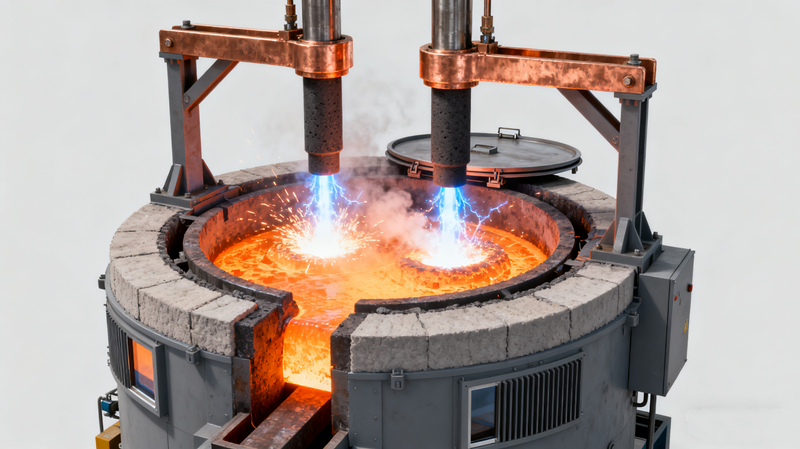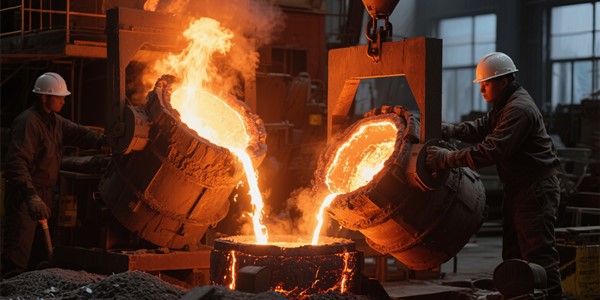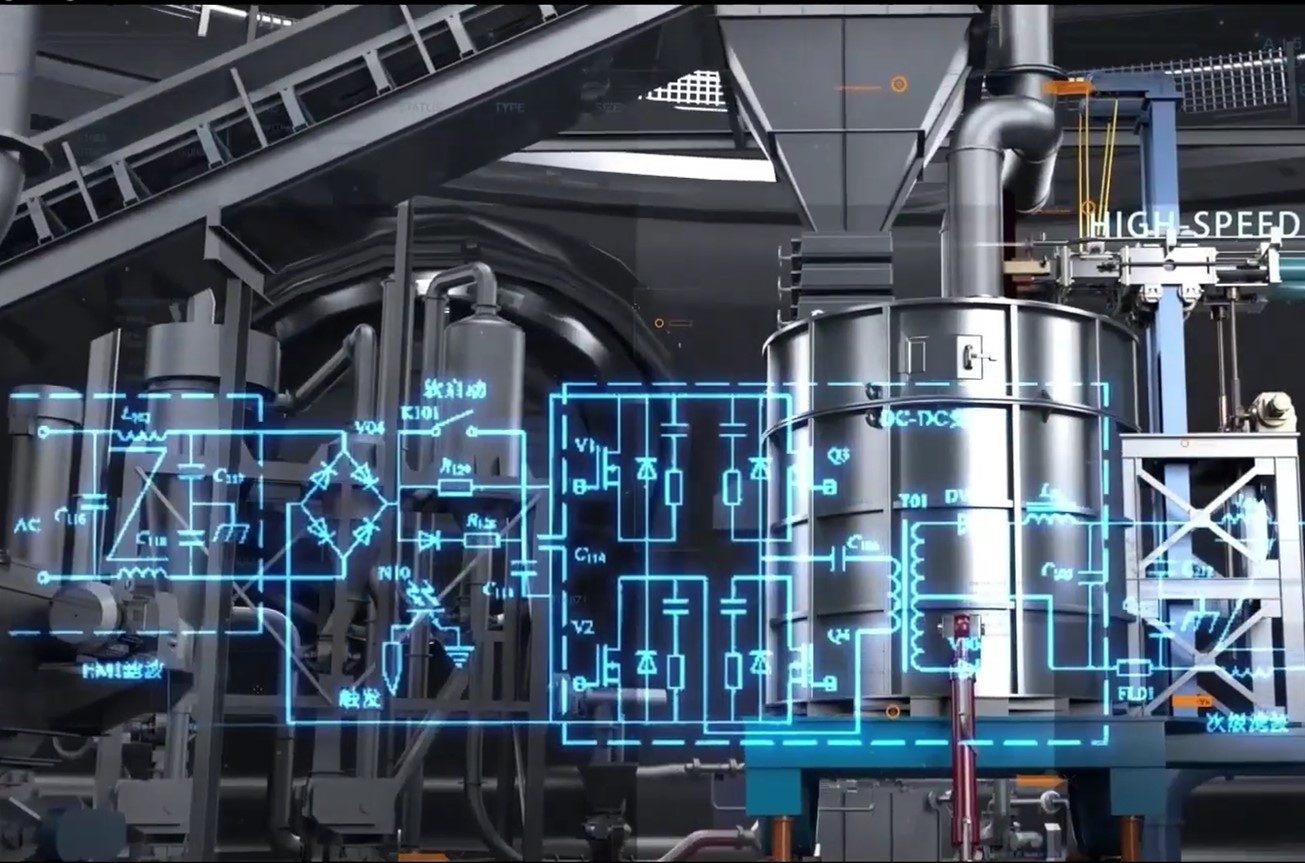
The DC plasma furnace consists of three main components: the plasma gun, the furnace body, and the DC power supply.
【1】The plasma gun consists of a water-cooled copper nozzle and a water-cooled cerium-tungsten rod electrode. The nozzle compresses the arc and serves as an auxiliary anode for generating non-transfer arcs. The cerium-tungsten rod or thorium-tungsten rod functions as the cathode. The nozzle and cathode are insulated yet allow argon gas passage. Argon flows from the upper part of the gun through the gun sleeve into the furnace, where it ionizes into plasma. Guns used on PAFs primarily employ direct current transfer arcs. Maximum gun power can reach 6.6 MVA. Smaller-capacity PAFs typically feature a single plasma gun mounted on the furnace top. Larger furnaces incorporate multiple plasma guns, usually installed around the furnace body at a 30° angle to the horizontal plane.
【2】The furnace body closely resembles that of a conventional electric arc furnace, featuring a water-cooled furnace cover, walls and floor constructed of refractory materials, and equipped with a furnace door and steel tapping channel. Graphite electrodes or water-cooled metal electrodes are embedded in the furnace floor to serve as the anode.
【3】Since PAF smelting in an inert atmosphere lacks decarburization stirring during the oxidation phase, an electromagnetic stirring coil is embedded in the refractory lining at the furnace bottom to ensure uniform temperature and composition in the molten metal pool. During smelting, a DC voltage is first applied between the cathode and nozzle, followed by argon gas injection. An arc is then initiated using a parallel high-frequency igniter. The high-frequency current breaks down the gap, ionizing the argon gas to generate a non-transfer arc, also known as the “small arc.” Next, a DC voltage is applied between the cathode and the anode at the furnace bottom, and the torch is lowered, gradually bringing the non-transfer arc closer to the charge. This causes an arc to form between the cathode and the metal charge, known as the transfer arc or “main arc.” Once the transfer arc is established, the circuit between the nozzle and the cathode is broken, extinguishing the non-transfer arc.
The primary process parameters for PAF are main arc voltage, main arc current, and argon gas flow rate. Current magnitude can be controlled by adjusting the gun position and regulating the current through the saturating reactor. Voltage magnitude is controlled by adjusting the thyristor firing angle. Argon gas flow rate is regulated via a flow meter.