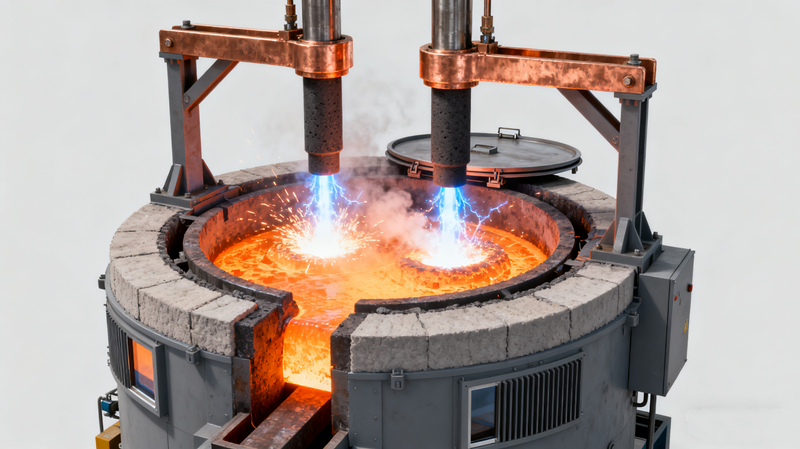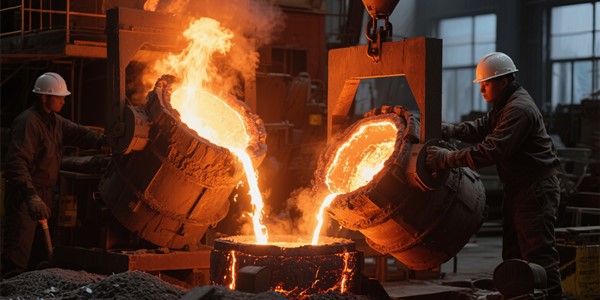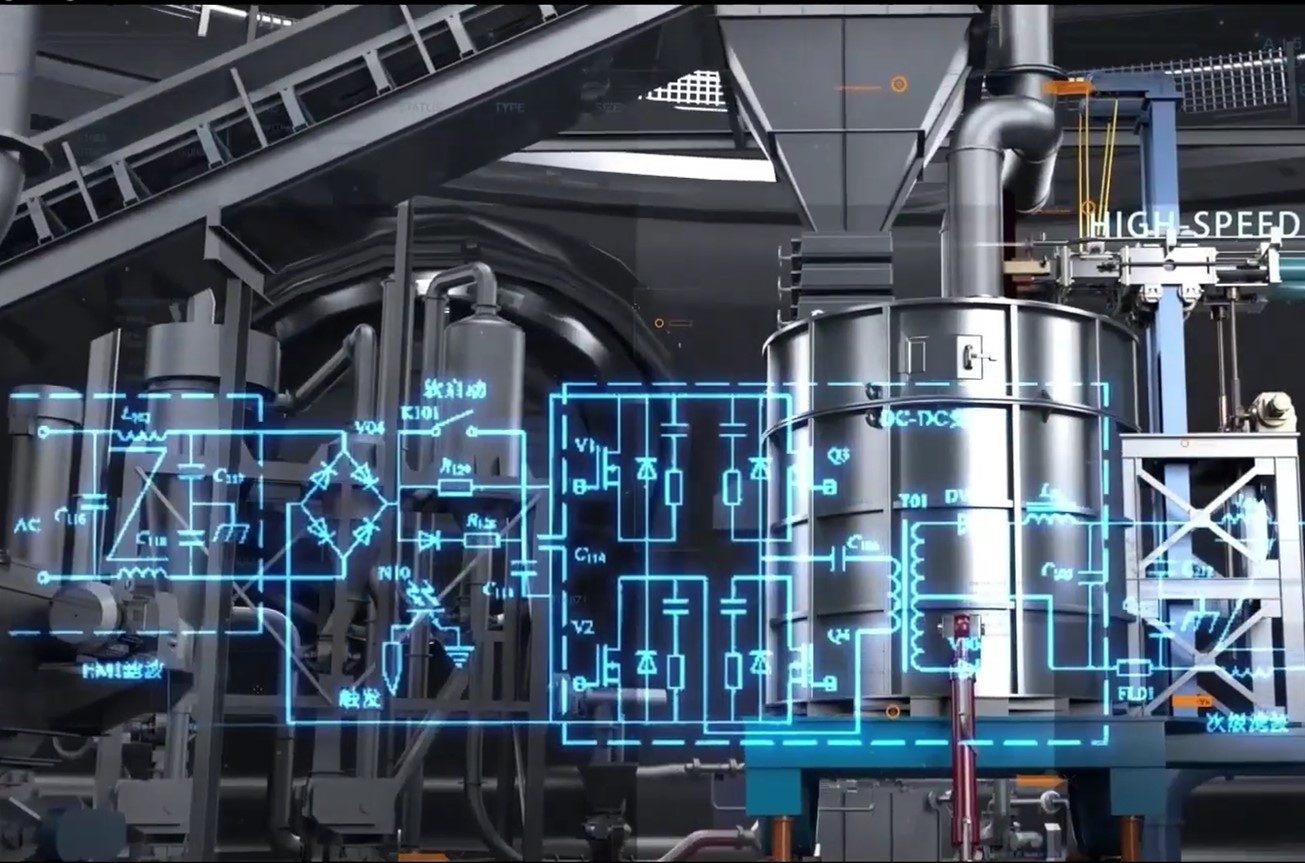
The electric arc furnaces (EAF) available on the market are broadly categorised into two types based on their current form: direct current (DC) furnaces and alternating current (AC) furnaces. Each type is further subdivided according to the state of the arc length into open-arc furnaces (where the electric arc is exposed outside the raw materials, also termed open-arc furnaces) and submerged-arc furnaces (where the electric arc is concealed within the raw materials, also termed submerged-arc furnaces).
AC electric arc furnace.
The AC furnace features a relatively simple structure, with three-phase alternating current connected to three electrodes, eliminating the need for complex rectifier circuits and thus offering lower production costs. Price represents a key advantage of AC furnaces. However, due to the inherent characteristics of alternating current, the arc light within an AC furnace undergoes a continuous cycle of ignition, extinction, re-ignition, and re-extinction, resulting in an unstable arc. Moreover, AC furnaces exhibit a lower power factor averaging 0.85, meaning 15% of electrical energy is wasted. This necessitates the addition of reactive power compensation equipment to raise the factor to 0.9. Furthermore, each AC furnace is meticulously calculated and designed according to the specific characteristics of the material being processed; one cannot arbitrarily alter the properties of the raw material. For instance, if the iron grade in your raw material was designed at 55% during the furnace’s development, and you subsequently obtain superior material with an iron grade of 80%, the furnace becomes unsuitable and must be adjusted to process material around 55% iron content. The arc length in AC furnaces also cannot be arbitrarily altered; for AC furnaces, the choice between open-arc and submerged-arc operation is fixed, and only one can be selected.
ANYANG YND DC electric arc furnace.
DC furnaces require rectifier circuits to convert alternating current into direct current. Under DC conditions, the mineral heating process does not repeatedly start and stop, maintaining a stable state. The power factor of DC furnaces generally exceeds 0.9. Based on electrode configuration, DC furnaces are categorised as single-electrode or double-electrode types. Single-electrode furnaces feature a single graphite electrode at the top serving as the negative electrode, while the positive electrode is positioned at the furnace bottom, termed the bottom electrode. Double-electrode furnaces house both positive and negative graphite electrodes within the furnace structure. The majority of DC furnaces commercially available are single-electrode types. However, single-electrode furnaces suffer from a significant issue: the base electrode is prone to damage. As the base electrode must contact the graphite bricks lining the furnace floor, which in turn must contact the raw materials within the furnace, extremely high temperatures are reached during smelting. Under continuous production conditions, the temperature of the graphite bricks can exceed 1000°C, causing the base electrode to melt due to the intense heat.
if you want to learn more information beside above, please contact me at sales@ayzj.net